Tisha B'Av
איכה — the cry that turns out to be a question back.
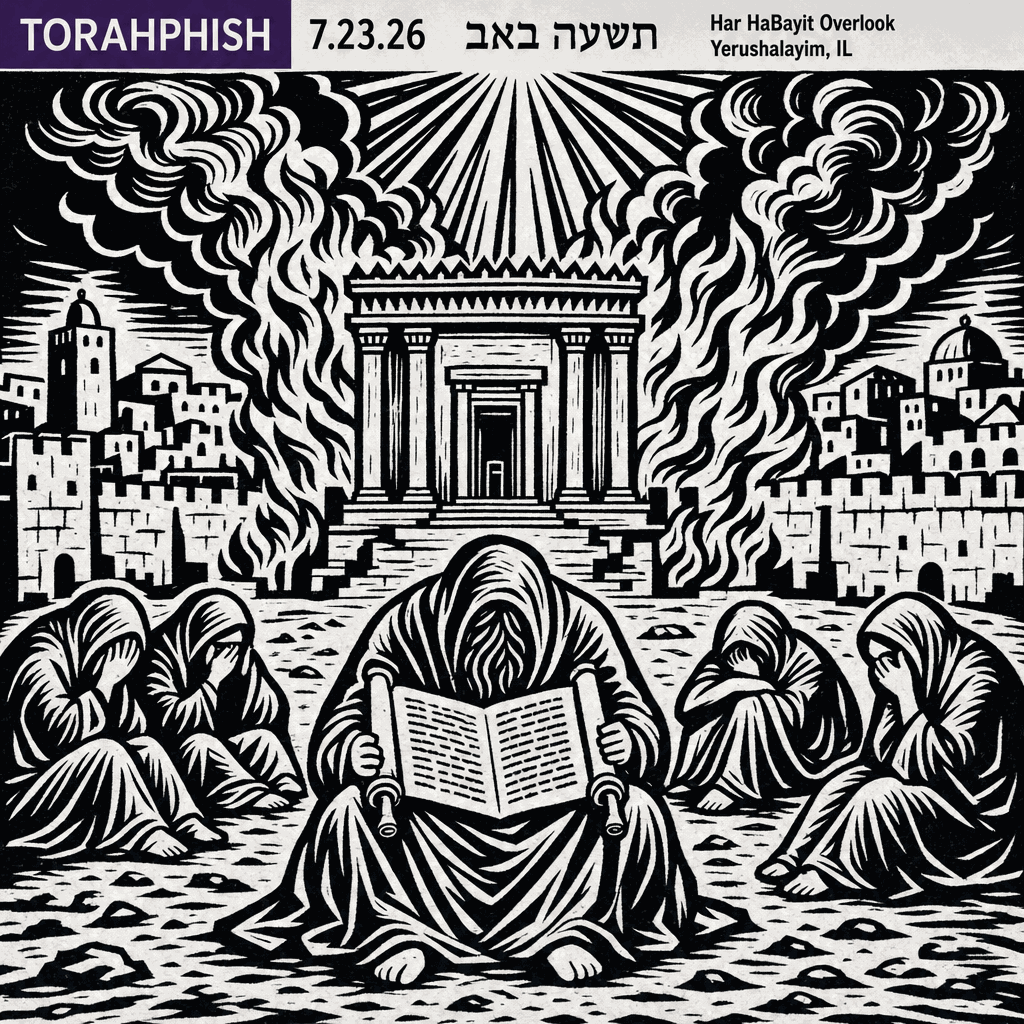
Twice, on the same date, the House came down. Tonight the lights go low, we sit on the floor like people with nowhere left to be, and we open a scroll that starts not with a sentence but with a sound: אֵיכָה — Eicha — "how." How does a city that held the whole world's gaze end up sitting alone? The scroll keens that question for five chapters and never once tries to explain it.
For one night the tradition tells us to stop pretending we're not 'falling into a deep well'. The day's own law puts the joy away — no learning, no greeting, the simple comforts set down — because tonight 'the simple smiles and good times seem all wrong', and we're meant to sit inside the loss without rushing to patch it.
Then the midrash turns the whole night over on a single word. It takes that opening אֵיכָה — eicha, "how" — and hears it in older vowels: אַיֶּכָּה — ayeka — "where are you?" The first question in the Torah, the one G-d calls out to the first human hiding in the garden. The mourner opens the scroll to ask his own question, how could You let this happen, and the very letters hand him back G-d's question, the older one: where are you? 'I know you heard the question but you didn't make a sound' — and the silence turns out to be the question itself, held open, waiting for someone to come home to it. The book will even admit the prayer feels barred, 'God never listens to what I say', and right there the tradition insists שערי דמעה לא ננעלו — the gates of tears are the one gate never locked. The crying is already the road back in.
And it comes down to how the second House fell. The first fell to idols and bloodshed. The second kept the whole machine running — learning, offerings, chesed — and came down anyway, to שנאת חנם, sinat chinam, a generation that observed everything and couldn't stand each other. The walls had been standing on the people inside them the whole time, on whether they could look at each other and see gems, and the moment that went the stones were a formality. Which is how Rav Kook could write the most hopeful line anyone ever set down over a ruin: a house that fell through baseless hatred gets raised again through אהבת חנם, ahavat chinam, baseless love. Anyone who rode that Slave at Lakewood on the fourth of July, 1999 — the one that grinds low and patient in its own bondage, longer than seems bearable, and then climbs, and climbs, until the whole thing breaks open overhead into light and the room lifts at once — knows that turn in their body. 'We're all here together in a spirit family'. That turn is the entire day. The tradition even says Mashiach is born davka on Tisha B'Av: the lowest point is where the next story is already being born, 'the squirming coil of sunset I keep within my reach'.
So we sit on the floor and cry the question upward. And the answer keeps coming back down as the same word: where are you? 'I'm vibrating with love and light' — and that, it turns out, is what the whole long mourning was for.
May we answer the ayeka this year — with ahavat chinam, with the plain daily work of seeing each other as the gems we are — and may the House we're crying for tonight be the one we're dancing in before the year is out.
Tzom kal, phriends.
- Slave to the Traffic Light▶ listen1999-07-04 · Lakewood Amphitheatre, Atlanta, GA
- Foam▶ listen1994-04-25 · Civic Auditorium, Knoxville, TN
- Sample in a Jar▶ listen2017-07-25 · Madison Square Garden, New York, NY
- Walls of the Cave▶ listen2004-06-19 · Saratoga Performing Arts Center, Saratoga Springs, NY
- Lifeboy▶ listen1994-06-18 · UIC Pavilion, Chicago, IL
- Set Your Soul Free▶ listen2021-09-05 · Dick's Sporting Goods Park, Commerce City, CO
- The Squirming Coil▶ listen2016-09-03 · Dick's Sporting Goods Park, Commerce City, CO
- More▶ listen2017-07-23 · Madison Square Garden, New York, NY
Eicha (Lamentations) 1:1 — אֵיכָה יָשְׁבָה בָדָד / Eicha Rabbah, Petichta 4 — the eicha → ayeka reading (R' Abbahu; cf. Bereishit 3:9, אַיֶּכָּה) / Yoma 9b — מפני שהיתה בו שנאת חנם (the second Beit HaMikdash and baseless hatred) / Berachot 32b — שערי דמעה לא ננעלו (the gates of tears are never locked) / Rav Kook — the ahavat chinam teaching (widely taught in his name; cf. Orot HaKodesh III)