Vaetchanan
the prayer you need before you can pray.
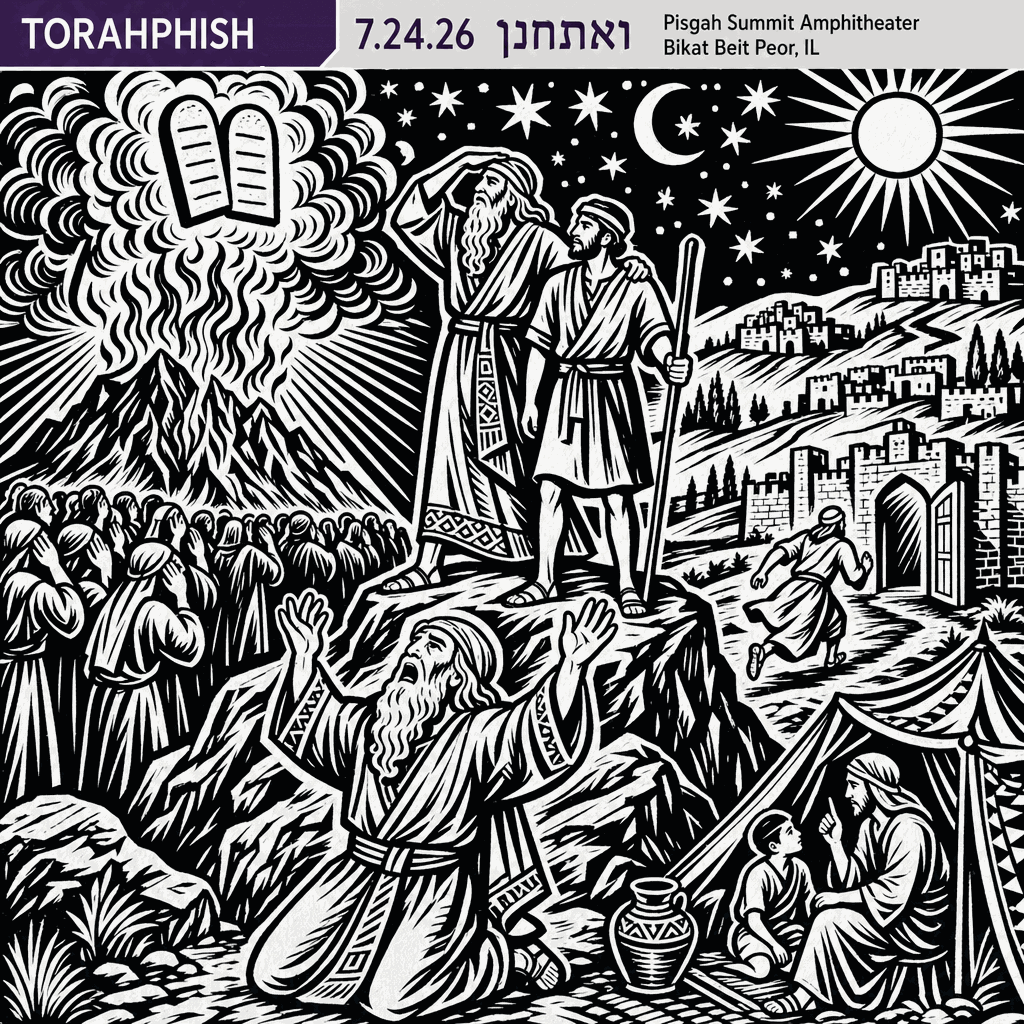
Moshe has one request left in him and the parsha refuses it. The greatest master of tefillah who ever lived asks אֶעְבְּרָה־נָּא, "let me cross over," and the answer is no. But the Kedushat Levi finds the gift hidden inside the refusal. He hangs the whole scene on one extra word — לֵאמֹר, "saying" — and teaches: יש לנו ב' בחינות בתפלה — "we have two dimensions of prayer: the prayer itself, and the prayer that one be able to pray." There is the thing you ask for, and beneath it the deeper thing: that you are able to ask at all. Before Moshe could daven for the land, he had to be given the words. In Colonel Forbin's Ascent the Colonel climbs his mountain and is promised 'I'll help you with your quest to gain the knowledge that you lack' — you don't scale the peak and seize the answer, you're handed the thing you were missing. Moshe climbs Pisgah and is given, in place of the land, a voice.
And that voice is the whole point. What Moshe receives at Chorev is קוֹל גָּדוֹל וְלֹא יָסָף — which Onkelos renders קָל רַב וְלָא פְסַק, a voice that never ceased. It is still sounding right now; the only question is whether you can hear it. That is the second prayer — not the words you say, but the open ear that receives what is always being given. 'Concepts I'll ponder and concepts I won't ever see' is the deal: you don't carve it or hold it in your hand, only catch it. Anyone who was on that dark airfield up in Limestone, Maine for the Bathtub Gin that unspooled the second night, August 17, 1997, knows this in the body. It is remembered as the finest of them all, and no one can quite say why — nothing "happened," no single peak or lick you could point to. It was tens of thousands yearning in one direction until the music began, somehow, to pray itself: the jam receiving far more than the players were putting in, a downpour of shefa that fell only because the whole field had gotten out of its own way. That is the second prayer made audible. And you do not walk away from a night like that with a souvenir — you walk away with the keilim, the vessels to daven from a depth you did not know you had.
Which is why the parsha's deepest fear is that we forget — that we lose the ear — and 'things are true that I forget' is the plain condition of being human. So its central command is not a doctrine but a capacity: שְׁמַע, be able to listen. Daven, then, for the prayer before the prayer. Not only for the thing you want, but for the power to want it rightly, to turn, to be present, to let the voice that never stopped reach you. And that gift is already yours for the receiving — 'this is your song too'. May we each be granted not only our requests, but the open ear to catch what is always, still, being said. Good Shabbos, phriends.
- Colonel Forbin's Ascent▶ listen2017-07-30 · Madison Square Garden, New York, NY
- Bug▶ listen1999-12-31 · Big Cypress Seminole Indian Reservation, Big Cypress, FL
- Bathtub Gin▶ listen1997-08-17 · Loring Commerce Centre, Limestone, ME
- Character Zero▶ listen1997-11-26 · Hartford Civic Center, Hartford, CT
- Joy▶ listen2021-10-23 · North Island Credit Union Amphitheatre, Chula Vista, CA
Kedushat Levi, Deuteronomy, Vaetchanan 2 — the two dimensions of prayer / Onkelos, Deuteronomy 5:19 — קָל רַב וְלָא פְסַק (a voice that did not cease)